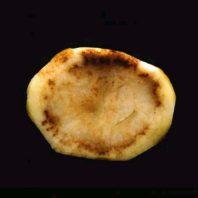
Peeled potato tuber showing infection by Phytophthora infestans. 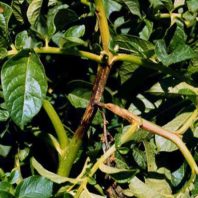
Late blight lesion on potato stem. 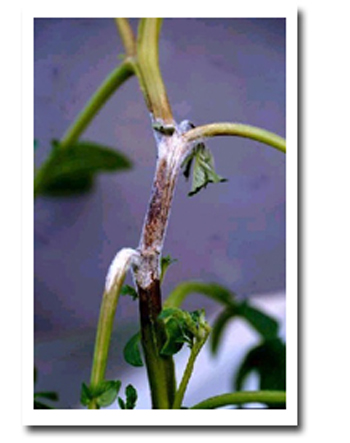
Late blight lesion on potato stem. 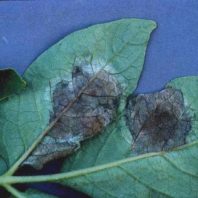
Late blight lesions on potato leaflets. 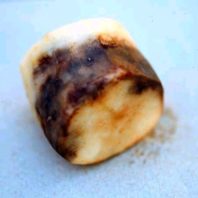
Late blight infection on peeled potato tuber. 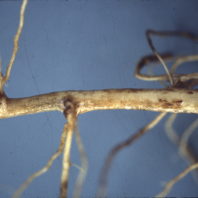
Immature sclerotia developing on belowground stem. 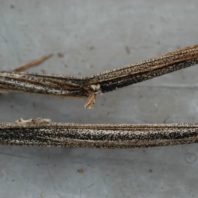
Black dot Sclerotia on dried stems. 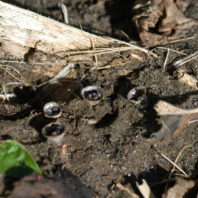
Fruiting bodies of a bird nest fungus. Do not confuse with apothecia of Sclerotinia 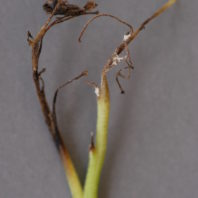
Sclerotinia lesion on the inflorescence stalk of a potato plant. The infection originated from a blossom contaminated with an ascospore. The ascospore germinated and mycelium reached the stalk before the blossom dropped. 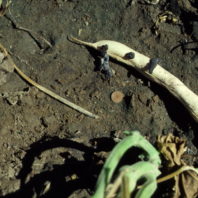
An apothecium on soil and sclerotia of Sclerotinia sclerotiorum on a bean pod. 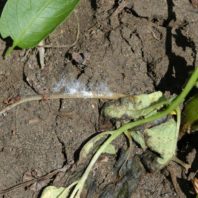
Mycelium of Sclerotinia sclerotiorum growing from dead potato foliage forming a mycelial mat on the soil surface. Any green potato foliage that may become lodged on the mycelial mat will become infected if sufficient moisture is present. 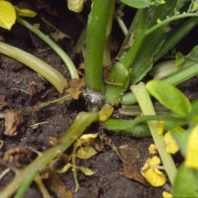
Sclerotinia lesion at the base of a potato stem. Lesions that girdle the stem near the soil surface may substantially reduce yield. 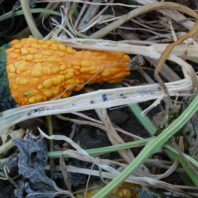
Young sclerotia of Sclerotinia sclerotiorum in stem of an ornamental squash. 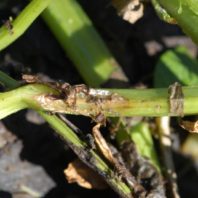
Young Sclerotinia lesion developing on a potato stem showing plant debris from which served as a substrate for ascospores to germinate, produce mycelium and infect the stem.
Disease Management
- Bacterial Stem Rot
- Black Dot (Word doc)
- Early Blight (Word doc)
- Late Blight (pdf)
- Leaf Roll (Word doc)
- Silver Scurf (Word doc)
- Sclerotinia Stem Rot (Word doc)
- Verticillium Wilt (Word doc)
Research Articles
- Effect of Extended Crop Rotations on Incidence of Black Dot, Silver Scurf, and Verticillium Wilt of Potato (pdf)
- Late blight epidemics in the Columbia Basin (pdf)
- Aggressiveness of Phytophthora Infestans Genotypes on Potato Stems and Leaves at Three Temperatures (pdf)
- Inferring outcrossing in the homothallic fungus Sclerotinia sclerotiorum using linkage disequilibrium decay (pdf)
- Relationship between Silver Scurf Levels on Seed and Progeny Tubers from Successive Generations of Potato Seed (pdf)
- Effect of Post-Harvest Fungicides and Disinfestants on the Suppression of Silver Scurf on Potatoes in Storage (pdf)
- Silver Scurf Management in Potatoes (pdf)
- Verticillium dahliae Populations from Mint and Potato Are Genetically Divergent with Predominant Haplotypes (pdf)
- Fungicide spray programs for Defender, A new cultivars with resistance to late blight and early blight (pdf)
- Late blight – Phosphorous Acid (pdf)
- Late bight – Protection of tubers with foliar fungicides (pdf)
- Late blight – Resistance in leaves, stems, flowers and tubers of potato clones (pdf)
- Late blight – Latent tuber infection (pdf)
- Late blight – Transmission from seed tubers to emerged shoots (pdf)
- Black dot – Vegetative compatibility (pdf)
- Black dot – Effect of azoxystrobin (pdf)
- Response of Colletotrichum coccodes to selected fungicides (pdf)
- Aerial stem rot (pdf)
- Powdery Scab – Genetic stability in potato germplasm for resistance (pdf)
- Verticillium wilt of potato -The pathogen, disease and managment (pdf)
Current Late Blight Forecast and Management Recommendations
Late blight Information line number is 800-984-7400
Contact Dennis Johnson at 509-335-3753 to confirm or to make late blight diagnosis.
Updated April 2016
Late blight has not been reported as of this date in the Columbia Basin. The disease is expected to occur according to the Columbia Basin Forecasting Model. However, probability of occurrence is lower than the last 5 years. The severity of the disease this year will depend largely on the extent that control tactics are applied. These include the following:
- Design irrigation systems to avoid irrigation overlaps.
- Plant certified seed produced from a seed production region where late blight did not occur or was successfully managed.
- Treat seed with a fungicide containing mancozeb or Curzate, such as Maxim MZ or Tops MZ.
- Plant seed pieces within 24 hours of cutting. This is important to reduce spread of the late blight pathogen during cutting and handling.
- Restrict irrigation until the crop is fully emerged.
- Do not irrigate potatoes within 80 ft of the pivot center.
- Eliminate culls and tuber refuse.
- Manage volunteer potatoes in fields where late blight was present last year.
Contact Dennis Johnson at 509 335 3753 to confirm or to make late blight diagnosis. Stay in touch with the late blight forecasts updated on this web site and the toll free information telephone one.
Good luck this season