- This event has passed.
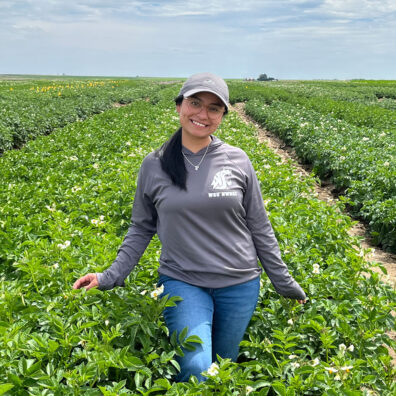
Francely Flores
March 9 @ 4:10 pm - 5:00 pm
 Title: Modes of seed transmission of plant pathogens and their epidemiological importance
Zoom Meeting Information
Zoom Link
Zoom Meeting ID: 959 0545 7360
Zoom Password: 2488
Bio
Francely is currently a Ph.D. student in the Berry and Potato Pathology Program at the Mount Vernon Northwestern Washington Research and Extension Center. She earned her B.S. in Agricultural Engineering from EARTH University, Costa Rica in 2020, and her M.S. in Sustainable Tropical Agriculture from Zamorano University in Honduras in 2023. Her master’s research focused on the adaptability and yield performance of introduced tomato lines under greenhouse and open-field conditions in Honduras. She has completed international internships in the Dominican Republic and at the World Vegetable Center in Taiwan. Her current research focuses on the management of Verticillium dahliae, a soilborne pathogen affecting potato and several crops in western Washington. In her free time, she enjoys reading, listening to music, playing badminton, and drinking coffee.
Abstract
Seeds are foundation for successful crop production. However, seeds can also serve as an important source of primary inoculum for diseases and facilitate long-distance movement of plant pathogens [1,2]. Plant pathogens may be associated with seeds externally through contamination occurring in the field or during storage, or internally through infection of the embryo or non-embryonic tissues such as the endosperm or perisperm, where transmission to the emerging seedling is not necessarily assured [1,3]. These different modes of pathogen transmission by seeds influence epidemiological risk and disease outcomes.
Across pathogen groups, transmission mechanisms vary but can lead to similar epidemiological consequences. Bacterial pathogens such as Xanthomonas citri pv. fuscans and Xanthomonas phaseoli pv. phaseoli, the causal agents of common bacterial blight of bean, may occur on the seed surface or within internal seed tissues and initiate epidemics at infection frequencies as low as one infected seed per 10,000 to 30,000 seeds. Hence, seed health and phytosanitary programs have set a zero tolerance level for this pathogen on bean seeds [4,5]. Fungal pathogens, such as Fusarium circinatum, which cause pitch canker disease of pine, are often externally seed-borne. However, they can still cause severe disease in forest systems due to high seedling mortality and latent infections, allowing the pathogen to persist undetected during early vegetative growth, particularly in nursery production of pine seedlings – a risk that has led to the implementation of quarantine and strict phytosanitary measures [6,7]. In contrast, seed transmission of plant viruses is biologically limited and typically requires infection happening during a narrow window of embryonic development [1,8]. This form of transmission represents vertical transmission, in which the pathogen moves from the parent plant into the seed embryo. Viruses such as pea seed-borne mosaic virus can infect embryo of the seed posing epidemiological risk, with risk levels varying among host cultivars [9]. In addition, certain nematodes, including Ditylenchus dipsaci, are true seed-transmitted plant pathogens that survive in seeds in a dormant state and introduced to new areas due to long distance movement of seed, often prompting strict quarantine measures [10–12].
A low frequency of seed infection does not equate to low epidemiological importance. Global seed trade amplifies these risks by enabling repeated and long-distance movement of pathogens beyond the limits of natural dispersal, while detection challenges at low infection levels complicate effective risk management [13,14]. Although advances in diagnostics and seed health systems have improved phytosanitary protection, important challenges remain, including identification of detection limits of pathogens relative to epidemiological risk, influence of environmental conditions on transmission dynamics, and the need for improved risk-based decision frameworks that link seed health test results to epidemiological and economic thresholds for phytosanitary decision-making [13,14]. The objective of this seminar is to examine how seed transmission pathways influence epidemiological risk and disease management across different plant pathogen groups.
Literature Cited
- Baker, K.F., and Smith, S.H. 1966. Dynamics of seed transmission of plant pathogens. Annu. Rev. Phytopathol. 4:311-332. https://doi.org/10.1146/annurev.py.04.090166.001523
- Elmer, W.H. 2001. Seeds as vehicles for pathogen importation. Biol. Invasions 3:263-271. https://doi.org/10.1023/A:1015217308477
- International Plant Protection Convention. 2025. International movement of seeds. https://www.ippc.int/en/publications/84340/
- EFSA Panel on Plant Health. 2014. Scientific opinion on the pest categorisation of Xanthomonas axonopodis phaseoli and Xanthomonas fuscans subsp. fuscans. EFSA J. 12:3856. https://doi.org/10.2903/j.efsa.2014.3856
- Chen, N. W. G., Ruh, M., Darrasse, A., Foucher, J., Briand, M., Costa, J., Studholme, D. J., and Jacques, M.-A. 2021. Common bacterial blight of bean: A model of seed transmission and pathological convergence. Mol. Plant Pathol. 22:1464-1480. https://doi.org/10.1111/mpp.13067
- Evira-Recuenco, M., Iturritxa, E., Raposo, R. 2015. Impact of seed transmission on the infection and development of pitch canker disease in Pinus radiata. Forests 6:3353-3368. https://doi.org/10.3390/f6093353
- European and Mediterranean Plant Protection Organization 2019. PM 7/91 (2): Fusarium circinatum (formerly Gibberella circinata). Bull. OEPP 49:228-247. https://doi.org/10.1111/epp.12587
- Wang, D., and Maule, A. J. 1994. A model for seed transmission of a plant virus: Genetic and structural analyses of pea embryo invasion by pea seed-borne mosaic virus. Plant Cell 6:777-787. https://doi.org/10.1105/tpc.6.6.777
- Beck-Okins, A. L., del Río Mendoza, L. E., Burrows, M., Simons, K. J., and Pasche, J. S. 2022. Pea seed-borne mosaic virus risk analysis of field pea based on susceptibility, yield loss, and seed transmission. Plant Dis. 106:938-946. https://doi.org/10.1094/PDIS-06-21-1349-RE
- Holajjer, P., Jadon, K. S., Chandrawat, B. S., and Gawade, B. 2020. Seed-borne and seed-associated nematodes: An overview. Pages 355-368. in: Seed-Borne Diseases of Agricultural Crops: Detection, Diagnosis & Management. R. Kumar, and A. Gupta, eds. Springer, Singapore. https://doi.org/10.1007/978-981-32-9046-4_15
- Green, C. D., and Sime, S. 1979. The dispersal of Ditylenchus dipsaci with vegetable seeds. Ann. Appl. Biol. 92:263-270. https://doi.org/10.1111/j.1744-7348.1979.tb03872.x
- European and Mediterranean Plant Protection Organization. 2017. PM 7/87 (2) Ditylenchus destructor and Ditylenchus dipsaci. Bull. OEPP 47:401-419. https://doi.org/10.1111/epp.12433
- Munkvold, G. P. 2009. Seed pathology: Progress in academia and industry. Annu. Rev. Phytopathol. 47:285-311. https://doi.org/10.1146/annurev-phyto-080508-081916
- Munkvold, G., du Toit, L., and Dunkle, R. 2025. Seed pathology: Challenges and advances in ensuring a safe global seed supply. Annu. Rev. Phytopathol. 63:43-62. https://doi.org/10.1146/annurev-phyto-121423-093855